Wednesday, 30 January 2013

The most hilarious dive in history!

Location: Eastern Kings – Type: Shore/Reef wall drop off – Max Depth: 29.9m – Length: 40 mins – Surface: Clear/Night

…MOST HILARIOUS DIVE IN HISTORY!!
1. Lost reef = lay on it! (12m)
2. Buoyant – buddy L holding to stop ascent (28 > 24m)
3. Realised – dumped air – face planted reef (24 > 28m). K caught me! 
The above is the entry from my buddy in my logbook which she took it upon herself to write after the events of, as she puts it, the ‘most hilarious dive in history’.

Just a few days after deciding I wasn’t quite ready to dive Eastern Kings, the tables had turned and I was getting set to give it a go one evening. The reef sits just off Devil’s Point (below the yellow buoy out to the left of the swimming pool) and is essentially a reef wall which drops off to 30 metres on one side and 40 on the other (I’d be sticking with my certified 30 metre limit). You have to dive the site at either high or low water, entering around 20 minutes before, otherwise you face a ropey return to shore battling a strong current in a shipping channel. You can’t use an SMB (because, as mentioned, you’re in a shipping channel) and if you lose your buddy you can’t do the usual minute search and surface (yup, it’s that pesky shipping channel again); you have to follow a bearing of 330 degrees back towards shore and only surface when you get to around the 1.5 metre mark. Not much info to keep in your head then!
There were four of us in the group and I was buddying up with someone who I trust implicitly when it comes to diving. If she hadn’t offered to guide me on my first Kings experience (she’s dived it countless times), I doubt very much I’d have done it yet!
At Kings you follow the sloping bottom down to the reef at around 12 metres and then gradually get to 30 metres by following the wall. Although I knew roughly how the site is shaped, I seemed to forget all of that once we’d got a little way down. I’m still trying to figure out how much weight I need with my new BCD and with a 15 litre cylinder instead of 12 as this was a deep dive I was having problems with my buoyancy. We got to 12 metres and the start of the wall, but not expecting such a drop, I started sliding down the wall. I managed to fall on my back with the cylinder weighting me down and essentially became pinned against the reef wall! At that point I didn’t realise I was on the wall and wasn’t making much of an attempt to right myself. My buddy had to pick me up and turn me round after realising I was getting nowhere fast!

Mishap number one complete and I couldn’t believe the sights that greeted me on the reef. Considering it was so dark, the vis was phenomenal and the colours, and range, of life under torchlight incredible. Just a few metres along the wall we bumped into a gigantic lobster. I’m betting he was about two feet long. He was a classic common red lobster but was shimmering under the lights looking rather pretty. This was the first of many times I wish I’d had my camera but given it was my first dive at the site I wanted to concentrate and as it turned out, it was the right call! Fortunately one of the others in the group had his camera so captured a lot of what we saw (thanks to him for letting me use his pics) though missed this beauty after taking a different path. Instead he met some smaller siblings along the way.


Our lobster was a grander version of this little fella

After the girls played a game of ‘let’s see how quickly Mr Lobster can move when encouraged by the light’ (pretty damn fast actually) we moved on through an array of crabs, spiny squat lobsters, olive squat lobsters, ballan wrasse, pike, tompot, sponges, anemones, starfish…it truly felt like all my Christmases had come at once. I was in awe of my surroundings and squealing like a kid, so much so that I very nearly headbutted a large metal pole sticking out of the sandy bottom along the way.

A very pretty anemone


A devil crab - okay, so that's not his real name (he's a velvet swimming crab) but you can see why!

A scorpion fish

A ballan wrasse
I was still having a few buoyancy problems at this point but nothing too drastic and managed to correct myself a couple of times while my buddy made sure I was in the right place the rest of the time (unbeknown to me until afterwards when she said she’d been holding onto me by the SMB attached to me at times to make sure I stayed in one place). That’s taking the guide role to a whole new level!
It was at 28 metres that the moment that resulted in this post’s title came about. What went wrong I’m still not quite sure, but regardless of that, we came to a point where I started drifting upwards quite quickly. My buddy was behind me and sprang in to action just in time to catch a fin while I was struggling to find my inflator hose to get rid of some air. I’d managed to get my snorkel tangled up with my hose and couldn’t get a hold of the deflate button properly, hence still creeping upwards. Having eventually managed to grab it, my logic was that I’d gone up so fast that I needed to get rid of a lot of air. So I held the button down as long as I could. Bad idea! In the space of a few seconds, I’d gone from my buddy holding my foot while I ‘stood’ vertically in the water above her,  to ditching all of my air, falling four metres, and hanging vertically upside down. All credit to her, my buddy was still holding onto my fin, albeit from a very different angle. As amusing as that sounds in itself, here’s the clincher. What I didn’t realise was that one of the others in the group was directly below us, a few metres down from where my comedy ascent/descent had started, so I’d managed to land head first on top of her, face planting the wall at the same time. As unsuspecting as she was, she did a great job of catching me!

After the drama of that part of the dive, we made our way back to shore a little more gracefully (though I still needed a helping hand). Somewhere near the end as the water was getting shallower I disappeared on up and promptly descended back down. My buddy said she was going to follow then decided I’d come back!
The below graph of my dive profile will give you some idea of my variety of ascents/descents. Generally, the smoother the line, the more controlled your buoyancy was, so you can see from the sharp spikes I was having problems!
Profile logged by my dive computer. Spikes = buoyancy issues!

We surfaced at the end of the steps up to the swimming pool; a perfect bit of navigation from my buddy. My first words: ‘Incredible’, ‘embarrassing’ and ‘what the hell happened there?’. Her first words were incomprehensible through her laughter! My entertainment value is priceless!
We got rid of our kit (I still had to be helped up the steps after the cylinder got ten times heavier out the water) and headed back down to the shore to meet the others. My buddy greeted the diver who I landed on with a shout of ‘nice catch’ while I muttered an apology of sorts!

Despite the various incidents, I’ve no doubt my first Eastern Kings experience was my best dive to date. It may not have been perfect in terms of best practice, but we saw so much, the vis and conditions were amazing, and we laughed until we were close to tears.
At every opportunity while you’re training, PADI literature will tell you that ‘diving is fun’. How right they are!

Sunday, 27 January 2013

N-ice time for a dive

I’ve been finding myself doing more and more dives lately, and the more I do, the more I want to do! If I were to continue writing about every dive as comprehensively as I’ve done so far, I’d probably have to miss out on a couple of dives in favour of updating this blog, and that, my friends, just isn’t going to happen. As much as I love capturing the fun and frolics of every outing, I’ve decided I’ll have to start being selective. Otherwise I’ll get repetitive strain injury from typing so much and you’ll get bored too easily.

Instead, I propose a brief (don’t look up the dictionary definition of that word after you've read this post) mention of each dive but will stick to the detailed ramblings for the most enjoyable and interesting underwater adventures. In the last ten days I’ve logged six dives. By my standards (and that of diving in the UK in a wetsuit in January) that’s pretty impressive!

Location: Waterfront – Type: Shore – Max Depth: 7.3m – Length: 36 mins – Surface: Icy
It started with a trip to the Waterfront off Plymouth Hoe one evening. That was the day it snowed. I’d woken up to a blanket of the white stuff, a few centimetres deep. At 7am I was playing in the snow in my garden (as was Scuba Smurf), and by 7pm I was under the sea.

Scuba Smurf going for an ice dive
 
I think the word ‘mad’ was bandied around a few times during the afternoon prior the leaving work, but it was 8c in the water; none of that -1c we had on the surface.

We had a decent dive. The vis wasn’t great and I took a while to settle in having not done a night dive for a while, but I enjoyed it, saw a few different creatures and had fun with my two buddies. It did however scupper my plans to dive Eastern Kings (a 30-40m reef off Devil’s Point) late the following evening for a friend’s 21st birthday. Having not done the site before (we tried on Xmas Eve but the vis was so bad we called it) and still being a little wary of diving in the dark, I decided to leave that for another day as I didn’t want to ruin anyone’s fun by having to babysit me!

Location: James Eagan Layne – Type: Wreck – Max Depth: 21m – Length: 15 mins – Surface: Overcast
I joined a trip the following morning to the James Eagan Layne; a 7000 tonne US ‘liberty’ ship designed to carry large amounts of cargo, which was sunk off Whitsand Bay after being torpedoed by a German U-boat in 1945. I was with a new buddy today, someone I’d not dived with before, but she was comfortable with what she was doing so I was happy. Unfortunately the dive wasn’t to be. We descended to 20 metres, following the shot line onto the wreck, plummeting into darkness. It wasn’t that the vis was bad in the classic sense (there didn’t appear to be much sand/sediment in the water), it was literally just dark, which given that it was a bright day on the surface was a little too eerie for my liking.

We found a metal object sticking up next to where we’d landed which had a few sponges and the like on it so we left the shot in the hope that conditions would improve. Not a chance! We couldn’t find the shot line again (neither of us had torches as we’d not expected those conditions) so we had to put an SMB up to ascend. This had its positives. The last time I put an SMB up I had to let go as I didn’t have the lever to release the line down far enough so would have ended up rocketing to the surface. This time, with a little help from my buddy, I managed a successful deployment and we headed back to the boat, bypassing a safety stop at five metres along the way as the swell had increased and neither of us could hold our positions. It’s not recommended, but we hadn’t been down long enough and deep enough for it to be a worry and neither of us were planning on diving again that day. I was greeted with a high five on the boat from the skipper who had been diving with me during the previous failed SMB attempt; let’s hope I can do the same again next time!

Location: Eastern Kings…just visiting
The same day, I decided to pay a visit to Eastern Kings not long before midnight to see my friends’ surface and greet the birthday boy. As I’d had to pull out of the dive I wasn’t content with sitting at home wondering how they were getting on, so I positioned myself on the walkway next to the swimming pool at Devil’s Point, alongside a few others who I didn’t know but soon realised were there for the same group, and waited in freezing temperatures for the guys to surface. I have to say, despite not being in the water, I really enjoyed it. It was so peaceful sitting in the dark watching the sea glowing under the few lights around the area and it was great to find out what they’d seen on the dive. It was most definitely the first time I've indulged in chocolate cake in the early hours of the morning in that location! 


The birthday boy de-kitting 10 minutes before he hit the big 21

Location: Elk – Type: Wreck – Max Depth: 29.9m – Length: 20 mins – Surface: Clear

A few hours kip and with the birthday diving in full swing, I was back out on the boat to join the man himself (buddy y) and his girlfriend (buddy x) to visit the Elk; another wreck which resembled a fish bowl the last time I dived it. Buddy x had forewarned us she may have ear problems though had been fine the night before so we were hoping all would be well. Unfortunately she couldn’t clear on the way down so she had to wave goodbye and left myself and buddy y to continue on down which was disappointing, but onwards and downwards. Torch in hand (I’d learnt from the previous day’s experience, although the vis/light was far better), we arrived on the Elk at 30 metres to be greeted by an array of fish. It was great drifting over the top of them, though the current was playing havoc with my ability to stay still long enough to take a decent photo!

There's a fish there...honest!
 
All too soon we had to think about surfacing. Our computers were down to 10 minutes’ no-decompression time, which is generally the point you make your way up. We ascended casually and planted ourselves at five metres for the safety stop. Having not achieved much photographically speaking on the bottom, I set about capturing some stunning portraits of some lesser known species at that depth; well, I went with what was available!

Buddy Y and moi

The shot line on the way up

My computer had completed the three minutes, but I was still waiting for buddy y to clear. We waited and waited (all of a couple more minutes) and then he told me to carry on up. In retrospect, he agreed it might have helped to let me know that his computer had told him to do another safety stop at three metres (something to do with having done a couple of dives in the previous 24 hours and the computer settings being conservative) but he was concerned I was getting cold. I on the other hand, on hovering at the surface wondering what he was up to, was getting concerned myself. Having got a yell from the boat to ask if everything was okay (I should have signalled okay on surfacing rather than continue looking under water), I hovered for a bit longer and buddy y appeared, none the worse for wear and asking why I hadn’t got back on the boat! Next time I’ll just stay in the same place!

After a great weekend of diving, a stop off at the local pub and a quick check of the tide times threw up plans for the next day and what was to become the ‘most hilarious dive in history’. But that’s a story for another day.
In the meantime, I’ll leave you with this little gem…I found Nemo (almost)!

'I'm a real fish!'
 

Sunday, 6 January 2013

Twenty leagues under the sea

Location: HMS Scylla – Type: Wreck – Max Depth: 24.1m – Length: 40 mins – Surface: Overcast

No, I’ve not misspelt the title of the Jules Verne classic, this was my 20th dive. I’d hoped to hit this number before the end of 2012, but the weather stopped that from happening so it seemed apt that it was my first of 2013 just a few days into the New Year.

We were heading out to the Scylla; the first time I’ve had a chance to dive it since the wreck dive on the advanced course (if you recall, the conditions were very rough). It couldn’t have been a more different picture this time round. It was overcast but there wasn’t much of a swell and the further out we got the more the sun tried to poke out through the clouds. The biggest shock was the temperature. Our dive computers were logging 15c air temp (I was disinclined to believe mine but two others said the same). It had felt warm outside but that’s ridiculous for January!

There were 10 on this dive, nine familiar faces and nice to catch up with after the holiday, and one stranger. Though I didn’t realise he was a stranger at first. I like to be friendly and this guy was just hanging around at the centre not really talking to anyone. I thought I’d seen him around before and it’s not uncommon for me to forget names if I haven’t seen someone for a while so I set off with the line ‘I’m sure I’ve met you before but I can’t remember your name’. Introductions over (the name didn’t sound familiar) I heard sniggering behind me. I, of course, wanted to know what was so funny. ‘You’ve not met him, he’s not dived in the UK before.’ So my attempt at being friendly, followed up by ‘oh, you must just look like someone I know’ turned into what sounded like a really lousy chat up line (that really wasn’t my intention)!

I was buddied with someone who I became friends with very early on in my short diving career; we did our open water course together and I was looking forward to getting back in the water with her as we hadn’t dived together since the summer when she went off to Australia for a couple of months. Checks on the boat done, we entered the water and started descending. We had to stop a couple of times as I was having ear problems (nothing unusual and I’d pre-warned my buddy). We got down to 19 metres and my buddy signalled she had a problem so we both stopped. She then signalled that her heart was racing and she needed to go up. Before I had a chance to react she was off. I tried to keep up to start with but she was going too fast so I slowed my pace and carried on up the shot line. I passed a couple of other divers coming down the line, signalled as best as possible what had happened and that I was okay (one of the guys said later that from my overdramatic actions he knew exactly what was going on) and continued up. I stopped at five metres for the three minute safety stop, wondering whether in this situation I should do the safety stop then get to the surface and check on my buddy or stay where I was. I’d never been in that situation before!

Fortunately a few seconds later the final pair from the boat came down which included an instructor. She checked I was okay (by that time she’d already seen to my buddy on the surface) and signalled for me to stay where I was while she went back up. When she came back down she signalled for me to join them to make a three. I asked if my buddy was okay and got an ‘ish’ response. I knew they wouldn’t have carried on the dive if there was a serious problem so felt okay to continue. I found out afterwards that my buddy couldn’t get her breathing under control and just needed to get to the surface and breathe fresh air. Not recommended, but panic attacks underwater can happen. She was more concerned that she’d left me whilst I was more worried about her coupled with the uncertainty of what I was actually meant to do!

After that eventful start, the dive went well. We skirted around the starboard side of the Scylla while I kept myself busy taking photos. Visibility was about four metres at best though I’d say two to three for the most part and it was pretty dark though brightened up it certain places. The wreck is covered in Dead Men’s Fingers so that was the order of a lot of the viewing.

Dead Men's Fingers on the Scylla

When we made it up towards the deck we were greeted by a few starfish. I managed to snap a couple of pictures of some smaller fish with big beady eyes but was surprised there weren’t that many around. I think part of the issue may have been that I still need to work on taking note of my surroundings whilst making sure my buddy is still in sight as opposed to there not actually being any fish there! The one time I did stop to take the below photo I lost the other two briefly. They were of course just a little way along the wreck; I knew they couldn’t have got far if I continued to follow the side of the ship in the same direction.


Yet to discover what this little blighter is if anyone fancies enlightening me   
Before I knew it, or so it seemed, we were ending the dive. It always takes me a little while to settle into a dive and sort my buoyancy out so it feels like it’s over before I’ve had much of a chance to really enjoy it. I’d imagine that will improve with experience and this was also the first time I’d used my new BCD on a proper dive (discounting the failed xmas eve attempt) so although it was incredibly comfortable, as I used up my air I started floating upwards a little and had to make more of a conscious effort (nose dive and lots of breathing out) to stay down. It also took me a minute to start my ascent at the beginning of the dive in the first place so it may be that the extra padding in my BCD means I need a bit more weight; I’ll have to test that theory!

We settled onto the wreck where we weren’t disturbing any marine life to put up an SMB. The instructor got hers out, started to fill it with air and suddenly let go of it. The rule is if it doesn’t unravel properly and you’re hanging onto it, let go otherwise you’ll go shooting to the surface with it! I got mine out, not fully convinced I was going to manage it (wrong attitude to begin with I guess) as I’d only ever done it once before with help (incidentally, also on the Scylla). After fumbling about trying to unravel it and getting myself in the right position to hold the reel release lever down and fill the SMB with air, I went for it. All too quickly I was being pulled up with it so had no choice but to let go. Not a great result! Two SMBs down, we had to do a free ascent. All went fine. We did a safety stop at five metres though were told afterwards by the instructor who spent the whole time hovering above the two of us that in the interests of safety (i.e. a boat not realising we were there) it would have been better to bypass the stop altogether.

Back in the boat, we set about retrieving the lost SMBs. The elastic on the instructor’s had got caught around the reel which was why she had to let go. I had no good excuse, though on folding it back up I did realise that my reel has just over a foot of line that unravels by itself so I would say that I thought I have the release lever held down as it initially was unravelling when I didn’t at all! Reassuringly there was also a third SMB to pick up for one of the other divers, so it was a day of lost SMBs, which doesn’t happen often.

This was certainly a dive of new experiences. The first incident left me feeling like I need to review ‘what do I do if…’ situations. We discussed it afterwards and it seems that I did do the right thing making the safety stop but I’d like to go through it in a bit more detail, especially what would happen if I wasn’t aware there were still divers on the surface as there were this time. The second realisation is that I need to practise my SMB release skills! Scuba divers never stop learning!

Saturday, 29 December 2012

The night before Christmas


Twas the night before Christmas
And out in the sea
Were some mad scuba divers
My buddy and me

Location: Eastern Kings – Type: Shore/Reef – Max Depth: 3m – Length: 8 mins – Surface: Clear

In the weeks leading up to Christmas I decided I wanted to dive on Christmas Eve. I roped in (without any difficulty) a willing buddy and prompted to stamp my feet and moan every time the weather turned bad and another day of diving was cancelled in the fortnight beforehand, concerned that I wouldn't get my festive dive.
The day before, despite a few days of heavy rain and flooding in some parts of the country, my buddy (also an instructor and far more experienced than me) gave our little adventure the green light. I was warned that the vis would be pretty rubbish though. I didn't mind; any dive would do me however little we could see. It was Christmas, after all.

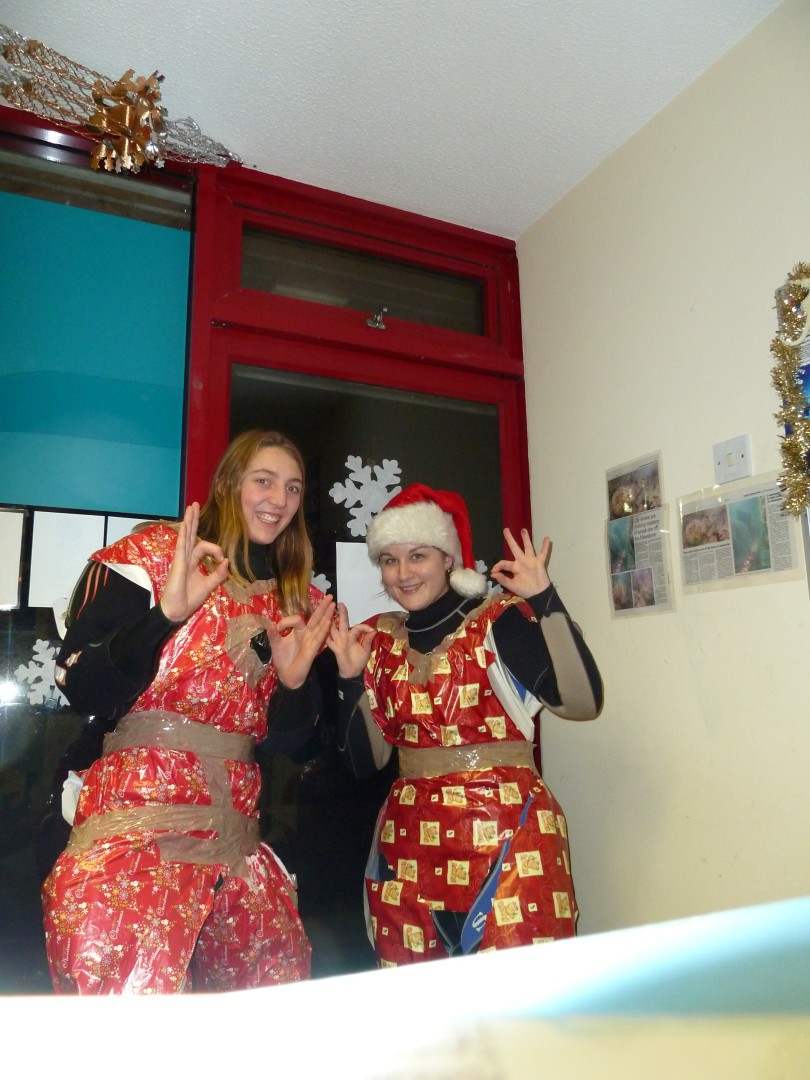
The eve of Christmas arrived and we met early evening to get kitted up in time to make ourselves look festive. Serious stuff aside, which included setting up my new BCD and regs for the first time, we moved onto the fun bit. I'd planned on Xmas hat and tinsel. A text from my buddy earlier that day alerted me to the fact she may have bigger ideas; 'I'm going to parcel myself later, so I may need your help!'. Now I do have a bit of a reputation for enjoying fancy dress, but I had to raise an eyebrow at this thought. Nevertheless, I'm game for a laugh and you know how the saying goes - if you can't beat the nutty scuba diver, join her!
My buddy and me wrapped for a scuba xmas

Trussed up in wrapping paper and realising that wearing it into the water may not be such a good idea as it was ripping with every step, we hopped in the van and headed to Devil's Point where the aim was to dive Eastern Kings; a reef that drops off to 30 metres on one side and 40 on the other. A quick check of the water revealed a calm moonlit sea so we were good to go. After decorating our BCDs and tanks with glowsticks (necessary to be able to see each other underwater in the dark) and unwrapping ourselves (!), we made our way down the path, onto the beach and into the sea.

It felt a little chilly at first as the water ran down the back of my wetsuit while I was being helped into my fins, but given that the air temp was 11c and the water temp had only gone down another degree to 10c in the last couple of weeks it was surprisingly nice. We descended and immediately realised the vis was practically zero. I lost my buddy straight away, then found her by bumping into her. If I could have attached myself to her I might've done at that point. Instead I just stayed as close as I possibly could next to her. Even that wasn't 100% effective; after losing her once and finding her again by pure luck after spotting a very faint glow in the distance (in reality she was probably about two metres away) we surfaced. By that point we'd barely gone anywhere and only made it three metres down!

We decided the planned dive was most definitely not dive-able. In daylight it may have just been doable as vis often improves at greater depth but at 9pm it wasn't going to happen! Disappointing, but we weren't willing to up sticks straight away. We decided on going back down for five minutes bimbling along the bottom to make the best of a bad situation. I wanted to use my new underwater camera and even though it was obvious not much was going to come out it was worth a shot!


This was about the extent of what we could see!
Amazingly, in all that murkiness, I did happen upon a little white crab making his way along the sand and tugged on my buddy's arm to let her know it was there. Of course when the signals are by torchlight and you can't see much anyway there wasn't much hope of relaying that message and crabby was too fast for me to follow. As I was attempting to make a crab sign (I figured wiggling my fingers around could work) she put her hand down to steady herself, exactly where I'd last seen the crab. Given that she wasn't wearing gloves, I was worried about the crab either being squashed or clinging onto her hand so pushed her out the way! I was only able to explain that palaver when I could speak later!

Back on the surface we took a few photos as evidence of our Christmas Eve dive (or dive attempt at least).


As I was trying to stand up to start making my way out I managed to fall over backwards. Not the first time I'd done this except this time as we were in really shallow water I'd forgotten to inflate my BCD when I came up. It was enough water to cover me so this upended turtle had to do a bit of breath holding while righting herself! Must inflate BCD next time! It did give me a moment to appreciate the moon though, almost full in the sky making the water glow around us.

Moment of reflection over, we made our way back to the van. It was a good couple of minutes’ walk so I not only got to test the new BCD in the sea, I tried out its fit on land and I'm glad to report the ScubaPro Bella is perfect for me. It was so comfortable! Very happy as I was a bit concerned it wouldn't be right for me trying it on beforehand, but as I kept reminding myself, I've only ever worn them with cylinder attached so I didn't have anything to compare.

As we hadn't taken any festive props into the water we stopped to snap a few Christmassy pics.


It seems we attracted the attention of a couple of lads in a passing car who couldn't believe they were seeing 'diver chicks' (yes folks, girls do dive) and that we'd actually already been in the water. So impressed were they that one of them hopped out to take a photo of us as evidence!

We may not have managed to do the dive we wanted but it was certainly the most novel Christmas Eve I've ever had and couldn't have been any more fun! My buddy summed it up perfectly; twas an epic adventure!


Progress

Location: Waterfront – Type: Shore – Max Depth: 7m – Length: 33 + 17 mins – Surface: Clear

What was supposed to be my final advanced dive, the deep dive to 30 metres, actually turned into my first dive without an instructor in the group. I've done fun dives before, but it just happens that usually there's an instructor buddying me or in the group. The boat had been cancelled so instead I made a group of four with others still wanting to get a dive in and headed to the Waterfront for a shore dive. The sun was shining splendidly and it was actually pleasantly warm getting ready. We entered off the small beach on the Hoe; to date I've only rolled in off the side or gone down the steps but low tide made beach access the easy option. Having said that, when you put your fins on you then have the walk, or waddle, backwards into the water so ‘easy’ may not be the best choice of word. I unceremoniously made my way in (aka stumbled) and settled (fell) into the sea.

We spent a little while paddling while one of our compatriots attempted to sort his fins out. He wasn't having much luck so we gave him a hand in the water. We didn't have much luck either! His fins were far too small! Fortunately there were students with us training that day so there were spare fins around and we soon set off. I was navigating, my buddy was holding the SMB and the boys were following behind. I have to say it's not the easiest of things multi-tasking underwater (no jokes please)! The vis wasn't that good so keeping track of the guys and keeping on course was interesting. I also had a habit of darting off a bit quickly so I need to work on that!

Along the way we saw sand gobies, a brittle star, spiny star fish and purple anemones. I also collected a couple of aluminium cans which I pocketed to dispose of later. If I'd had a bag with me I could've turned it into a recycling dive with the amount of rubbish that ends up near the sea wall.

I'd managed to navigate out in a straight line for a while before turning 120 degrees (I was working on a triangular pattern) and we'd got relatively close towards the sea wall before myself and my buddy realised we'd lost the boys. Standard practice is to look around for a minute then surface, which is what we did. We soon saw their SMB and went to join them. As we were only a few metres from the bottom we had plenty of air to continue the dive, but just a few minutes later they'd strayed again! Turns out they'd stopped to take photos!

One of the snaps taken on the dive when the boys' disappeared!
 
This time the rest of the group were getting a little cold and we were almost back to shore by that point so they went in and I joined another diver to carry on for a bit longer. We saw a female ballan wrasse fish on this stint. On researching ballan wrasse after the dive, I discovered that they are all born female and only a small proportion turn male after eight years. Obviously they're aware that females are the superior species!

I was holding the SMB this time round. When you're holding it you're meant to keep it at a reasonable distance from your body so you don't get tangled up in it. Hmm. I forgot that! There was suddenly something pulling on my fin and I ended up head down, feet up. I really thought someone was above me pulling me up. Then I realised I'd got caught up in the reel line! I managed to flag my buddy down who helped me untangle myself and we continued for a bit before surfacing.

The correct way to hold an SMB, away from your body. NB. The teacup is not essential for correct SMB positioning.
 
As neither of us had been paying much attention to a compass we ended up a bit far from shore so we took a bearing and descended again. Not for long! The low tide meant we were barely in two metres of water and kept popping back up to the surface. So we gave up on that idea and had a gentle paddle back in. It was quite an interesting vantage point to watch a huge warship head into the dockyard! I felt like a tiny fish myself!

We made it back in and out the water eventually. You'd think getting out on the beach would be far easier than climbing up large steps but the water got a lot shallower as we got in and I didn't realise that I was being pushed in towards shore. I ended up beaching myself on a rock! Having been dragged up once by my buddy I then had to be helped out the water by two of the guys who had gone in earlier as I couldn’t steady myself enough to get up! I wonder if my exits will ever start to look like I know what I'm doing?

Location: The Elk – Type: Wreck – Max Depth: 30m – Length: 28 mins – Surface: Overcast

Here we go! I'd finally got to the last dive on the advanced course. There aren't many skills involved on this one. The main thing is to make sure you can get down to 30 metres and still have your wits about you! As you descend further, the nitrogen in the air you’re breathing compresses more and you can be at risk of developing nitrogen narcosis. Basically, it means that you feel drunk underwater, so you get disorientated and could do something stupid. I've heard tales of people reaching for their BCD inflators with the intention of getting to the surface as soon as possible and being pounced on by their instructor/buddy while they get themselves under control; not something you want to be doing that far down! If it does occur, it can often be rectified by ascending a few metres, and it doesn’t necessarily mean it will happen again at the same depth.

We were heading to the Elk; an old trawler south of Plymouth’s breakwater used as a fishing boat which sank after hitting a mine in 1940. As we descended I was getting a few more ear problems than normal so it took a few minutes longer than usual, but I had expected it as I'd been ill the week before and still had a stuffy head. It wasn't bad enough to cancel the dive and I knew if I took it slowly I'd probably be okay. Fortunately I was right on this occasion. It's definitely not worth pushing it if you're in real pain though; the idea is you either manage to equalise or call it a day before that point and I know people who have had to do that.

After what seemed like ages, though in reality was probably only a few minutes, we hit the bottom. Instead of seeing a wreck, we'd ended up on the sandy bottom which was fortunate as I landed feet first, not quite realising we'd got there! You consume more air the deeper you go and it becomes harder to take breaths through the regulator. I knew I was breathing too quickly as I started to feel a little fuzzy. Fortunately the good thing was I realised I was doing it so I was able to correct myself quite quickly and start breathing at a more normal pace by taking a few slow, deep breaths with the support of my instructor who realised I was getting a little stressed. My surroundings were still a bit hazy but I knew I'd start to feel better soon so I plodded on.

We stopped on the sandy bottom to do the skills test; make five. The instructor holds up a certain number of fingers and you have to hold the amount up that makes the number up to five. I was fine on the first two doing it quite quickly. On the third he held up five fingers. It took me a minute to figure out how to make nought underwater (make a fist)! I thought he was trying to catch me out!

That done, we did a quick light test. The trainee divemaster shone a torch on something to show me the difference in colour once illuminated. I have to add that was after his torch was untangled from his BCD! Who says practise makes perfect? We continued to try to find the Elk. My instructor seemed quite happy with where he was going so I was happy to follow.

The deeper you get the less time you can stay down before you reach your no decompression limit so time was running short. I'm glad to say we did find the Elk and what a sight it was! It's only a small wreck but its deck is caved in and as such it's like a giant fish bowl! The critters are more than happy to have you swimming above them and continue on their path rather than darting out of the way. We were the only three diving the wreck at that point so I was told that had a lot to do with it. If you'd had a dozen divers down there they may have been more inclined to hide! We only had a few minutes on it but it definitely left me with a desire to get back onto it again soon. We surfaced with no drama, headed back to the centre and did the obligatory end of course photo for the certification. A few days later I was told that a somewhat embarrassed instructor, once I had left, had admitted that I'd come up having used less air than he had. The more experienced you are the less air you should use as you're more in control of your breathing so hearing this amused me! So there you have it, I'm now a qualified advanced open water diver. Wahoo!

A week later I tried to dive the Elk again, acting on the desire I'd had after the last time. Tried is the operative word though. We made it down 30 metres in somewhat rough conditions following another boat's shot line. No wreck in site! After a bit of a paddle along the bottom we called it a day and came up. So the Elk is still on the list to do properly! I was glad I had a chance to do another deep dive though. This time I was in control of my breathing the whole time and felt incredibly comfortable at that depth. I can't wait to do some more exploring.

Tuesday, 11 December 2012

The guiding light of nav and night

Time certainly flies when you’re underwater. Okay, so that’s not much of an excuse for the time since the last post, but I’ve been spending a fair bit of time down yonder and haven’t had time to sit down and type on the surface. Real life got in the way…until now! We left off with the completion of my second adventure dive towards the advanced qualification, so that’s where I’ll pick up.

Location: Jennycliff Bay – Type: Reef – Max Depth: 8.9m – Length: 48 mins – Surface: Clear

It was a rather chilly morning for the navigation adventure dive a week or so into November; 2c when I left home first thing but the blue skies and sunshine made the early start worth it and I’ve come to learn that if you’re a little nippy on the surface, once you get under the water you’ll be feeling toasty (okay, minor exaggeration, but definitely not freezing).

The first thing to do was refresh my memory on how to use a compass. We touched on it briefly in the open water course, but the last time I actually used a compass for navigation skills (you may wonder what else a compass can be used for) was around 12 years ago in a school PE lesson when, in orienteering, we were taught how to ‘move your body round the map’. Well I’ll tell you something; that ain’t a lot of help underwater! It’s a bit like when they said maths would come in useful one day…still waiting! School lesson inadequacies aside, we practiced on dry land and I made a half decent attempt to navigate a square. Somehow I kept ending up walking into a bollard in the car park when I didn’t start at that point but it was on the same line so it was close enough for me.

Once out on the boat and into the water (12c temp, certainly can’t complain), the real skills tests began. Jennycliff Bay is a reef, but for the purposes of this dive we lurked (no, not in that way) on the outer edges on the sandy bottom (again, it’s not how it sounds) so we had a level playing field to practice. As it was, the visibility wasn’t particularly good so it was a case of staying close together and next to the shot line and take it in turns (there were four of us doing the skills) with our instructor instructing (strangely enough) on what task was next. As well as using a compass, we had to use natural navigation, for example taking note of lines in the sand and following the channel along, or using a particular rock (where we were there weren’t many) to recognise where you started. I chose a reasonably sized starfish along the way using the theory that if he was on the left of me on the way out and the right of me on the way back I was going the right way. It seemed to do the trick (though in retrospect, he could have moved)! While one of us was doing that skill, your buddy had to count kick cycles (one cycle = every time you kick with a particular leg) and stop you when you’d done a pre-determined number. This went relatively well, though we hadn’t quite grasped that we had to stay really close to each other for this to work so by the time the person counting had let the other one go and started counting behind, buddy number one was left wondering why they hadn’t been stopped yet while buddy number two was frantically trying to catch up to let number one know they could stop! I’d imagine if we’d been filmed I’d have had to add the music that accompanies this video (stick with it, my point is made around 10 seconds in)…


(Please note, I don’t condone the idea of a shrimp on a treadmill, I actually feel sorry for the little fella, but who knew you’d get this result on YouTube when searching for the Benny Hill theme tune?)

The compass work didn’t go quite as well in the water as it did on land. Both myself and my buddy had difficulty getting the compass to work. We’d get to turn three and completely lose track of where we were because the needle wouldn’t move. Given that we both had the same problem we blamed the compass (naturally) despite our instructor proving that it worked a bit later. You win some, you lose some; we’re sticking to our story!

Advanced dive three complete, it was back to the dive centre in somewhat warmer conditions. The air temperature had crept up to around 11c by late morning but despite that, I’d come prepared and I was therefore going to wear my penguin hat to keep me warm! I possibly should have reassessed keeping it on after I’d changed. I got some funny looks in Sainsbury’s.

Location: Waterfront – Type: Shore – Max Depth: 10m – Length: 27 mins – Surface: Clear

The next course dive to check off the list was the night adventure, even though I’ve done a night dive before, albeit by accident (see below for that story). This time we started in the dark, as opposed to it gradually getting dark, so it was a case of kitting up on the side of the road and walking cautiously down the stairs to the edge of the water. It was a reasonable 11c air temp – considering it was 7.30pm in mid-November that’s pretty good going and meant there was no shivering this time round!

As the tide was in, it made entry pretty easy. It was a case of one step, two step, hello sea. One of the instructors had the job of putting four pairs of fins on us students; I’m sorry to say none of us have yet mastered putting these on in the water by ourselves! By that point my usually highly efficient torch was behaving inefficiently so the instructor switched it with his, reassuringly calling it the ‘sun’. I was reassured for all of five minutes when the ‘sun’ set. Not to worry; my instructor who was leading the group and buddying me had more than enough torch for the both of us, though I still carried on gripping mine in the hope that it might perk up again…it didn’t! I think someone needs to check the charger!

There wasn’t much by way of skills tests on this dive. It was more about acclimatisation to only being able to see by torchlight, but as this was the second time I’d found myself in this scenario it made for a relaxed evening. We practiced hand signals by torchlight (shadow puppets spring to mind) taking care not to blind anyone whilst doing so. We also had to really be aware of staying close together. One of the guy’s behind me in a different buddy pair said afterwards that all he could see was yellow fins and sand. I recommended not swimming quite so close to me in future!
Just the one dive left to become an advanced diver. As ever, plans are never fixed when it comes to timetabling dives, so it was to be another two weeks before I managed my deep dive, with a fun shore dive interlude in between. More on that next time!

Tuesday, 30 October 2012

Advancing on the Open Water: A Tale of Two Wrecks

Well, I’ve taken the plunge and signed up for the Advanced Open Water course to become qualified to dive to 30 metres. I want the choice of the majority of dives on offer with my club rather than having to stick to sites above 18m. I also want to be able to deep dive when I head off on my travels to Australia next year, which was what drove me to start scuba diving in the first place. Snorkelling may be enough for some on the Great Barrier Reef, but I want the best experience I can get!

In the last two weeks I’ve completed two of my five adventure dives towards the qualification. There’s a list to choose from, along with a couple of mandatories, which includes the deep dive which takes you to 30m. The main one I really wanted to do was the photography module but the visibility hasn’t been too great lately as the days get colder and darker so it looks like I might have to put that on the back burner, get the course done, and do that as a guided dive some other time.

I’m becoming increasingly aware that the sea’s getting colder (no sh*t Sherlock) and my wetsuit, though thick, may not be thick enough to give me a comfortable dive in the depth of an English winter (albeit on the warmer side of the coast). But I’m going to give it a damn good go!

Location: HMS Abelard – Type: Scattered Wreck – Max Depth: 11m – Length: 34 mins – Surface: Clear

As I set out for this dive from home at 8am the air temperature outside was 6c and inside my house it was 13c (yes, I did turn the heating on after that wake up call). The day before I’d been asking various people what the chances of the sea being warmer than the surface temp are. It wasn’t looking promising, but you learn something new every day. The sea is most certainly not like your bath (as in it doesn't cool down quickly, obviously I'm aware it isn't hot with bath bubbles) and I was surprised (shocked) to find it was a reasonable 14c. I was more than comfortable in my 10mm of neoprene. The boat trip on the other hand was a bit chilly. Fortunately the dive site was just off Plymouth’s breakwater, so it wasn’t much of a trip.

This dive was logged as my boat adventure dive, so even though I’ve dived off the boat a number of times before, this time I had to pay more attention to a detailed briefing to complete the knowledge review at the end. Once we’d rolled off the side of the RIB, it was back to enjoying the dive just like any other. It wasn’t particularly far down to the sea floor and once there we had a gentle paddle around the wreck site, with debris strewn far and wide. We didn’t manage to find the boiler, it’s there somewhere, but instead stumbled upon old lead pipes (sounds like something out of Cluedo) and other metal objects which no doubt came from the HMS Abelard; an old steam trawler which had been converted into a mine sweeper only to be sunk after getting on the wrong side of a mine on Christmas Eve 1916.

A few smaller fish, some starfish and crabs made for interesting viewing, but the highlight once again was a catshark, spotted by our instructor who, after a while of pointing, resorted to becoming a shark (hand, fin, head) to make us aware of our new friend. My last viewing of one of these was a couple of dives back and just like the last time, he casually sat on the bottom awaiting our passing, seemingly not bothered by four large black odd-shaped creatures. Bet his little heart was racing; he just put on a good show!

Location: HMS Scylla – Type: Wreck – Max Depth: 18m – Length: 32 mins – Surface: Overcast, choppy

I’ve wanted to do a wreck dive for a while; my previous attempts to dive another wreck, the Glen Strathallen, haven’t come to pass for various reasons. And so it was that my first was to be on HMS Scylla, a well-known wreck deliberately sunk off Whitsand Bay by the National Marine Aquarium in 2004 to become an artificial reef after it was decommissioned by the Royal Navy.
HMS Scylla was Europe's first artificial reef (MORE INFO HERE)
 
The trip out to the Scylla was somewhat of a thrill ride to say the least. With an air temp of around 10c and the sky looking an ominous grey, it was chilly. By the time we’d got out past the breakwater on the boat, the waves were building and the wind was biting. After being slapped in the face by a wave more than a few times, I donned my mask and snorkel; it was a wise choice! With the sea getting rougher, it took a while for the shot line to settle on the Scylla after a few attempts, which made one wet diver (I was the only one not in a drysuit) rather cold and wishing for a hot shower, and that was before getting in.

After a very wobbly kitting up session, we made it in and headed straight on down to calmer waters. As we got towards the wreck I could make out the general shape and not much else, thinking that the visibility must be really bad. It took a few moments to realise that my mask was steamed up. In my haste to get off the boat I’d passed my mask to the instructor to dip into the sea (I wasn’t trying that manoeuvre myself in such choppy conditions) but hadn’t spat on it first; the sure fire way to make sure you don’t steam up. After my instructor realised my predicament (I was told later it was pretty obvious despite my attempts to signal this by pointing at my mask and shrugging) he settled me on the deck and showed me how to clear it by letting a bit of water in, washing the lenses and getting rid of the water again. I was greeted by an array of fish swimming in front of me – amazing when you go from seeing barely anything to a whole new viewpoint!

The rest of the dive was taken up with skills tests which I had to pass as part of the course, including laying a line on the wreck to navigate, pointing out hazards (holes you shouldn’t go in) and releasing a delayed surface marker buoy (SMB) which is used for the boat to find you if you’ve drifted from the shot line. When you’re releasing one of these, you fill the inflatable part up with air from your octopus (spare regulator) and let go, being sure that you’re holding the trigger on the attached line down so that when the inflatable shoots off towards the surface you don’t go with it!

As I was concentrating on the tasks I had to do, I didn’t take much notice of the marine life around me. There was a bit of a current at 18m so I needed to focus on what I was doing whilst trying not to bash into the side of the frigate. There were a lot dead men’s fingers (I’ve been told if you go to the Scylla and don't see these you’re diving the wrong wreck), starfish and some small to medium sized fish. Others saw a couple of types of wrasse and various other species. I’ll have to wait until next time to fully appreciate the life around the reef.
Dead Mens' Fingers - each finger is a colony of tiny animals
 
That was my wreck adventure dive done and all challenges complete. I can’t say I felt that I performed the tasks particularly well, but I was assured I did the best I could considering the conditions. Onwards and upwards I guess. And upwards we went, into even higher waves. I was wrapped in a blanket as soon as I got on the boat, despite my protests. I’m so glad they did, as it soon got bitterly cold and by the time the other divers got back and we’d floated around for a while trying to pull the buoy attached to the shot line up in the worsening waves, I wasn’t feeling so hot (in more ways than one) either. It felt like a long trip back in but once inside the breakwater things started to get back to normal. It was just the cold I was left with, cured by a hot shower quickly after returning thanks to the kindness of one of my instructors who had clocked the serious shivering and offered to take my kit back to the dive centre. I can’t say how grateful I was!